Executive Overview
SBRC is developing a synthetic multinational accounting research platform to examine how business events become traceable accounting records across entity-specific frameworks and currencies. The programme focuses on classification discipline, controlled transaction processing, draft-journal integrity and the conceptual progression from event evidence to management analysis.
This is an ongoing research and development initiative, not a completed commercial product or a production-readiness claim. It provides an approved public view of methodology, architecture and demonstrated evidence while keeping private implementation material outside the website.
- Business Event
- Accounting Classification
- Journal Processing
- General Ledger
- Trial Balance
- Financial Reporting
- Management Analysis and FP&A
Research Objectives
- Develop a clear Chart of Accounts structure suitable for comparative multinational accounting.
- Study transaction classification and accounting controls in a controlled synthetic environment.
- Examine the conceptual progression from accounting events to drafts, journals and reporting outputs.
- Compare implementation considerations for US GAAP, IFRS and K-IFRS reporting contexts.
- Evaluate analytical and spreadsheet-based workflows for finance review and management reporting.
Accounting Framework
The methodology begins with event evidence and ends with clearly separated accounting outputs. Each stage applies an explicit classification, control objective and reporting use rather than treating all financial-system records as equivalent.
Classification
Chart of Accounts design separates account purpose, reporting classification and controlled mapping.
Processing
Transaction logic evaluates completeness and balance before a draft journal is considered ready for further review.
Reporting
Entity outputs are maintained separately from group presentation, where translation and consolidation effects may apply.
Multinational Accounting
The synthetic group baseline consists of four entities. US01 is the ultimate parent company. Entity accounting reflects functional-currency and framework considerations, while the group is presented in USD. The IFRS assignments for DE01 and UK01 are synthetic research baselines and are not definitive statements of statutory reporting obligations.
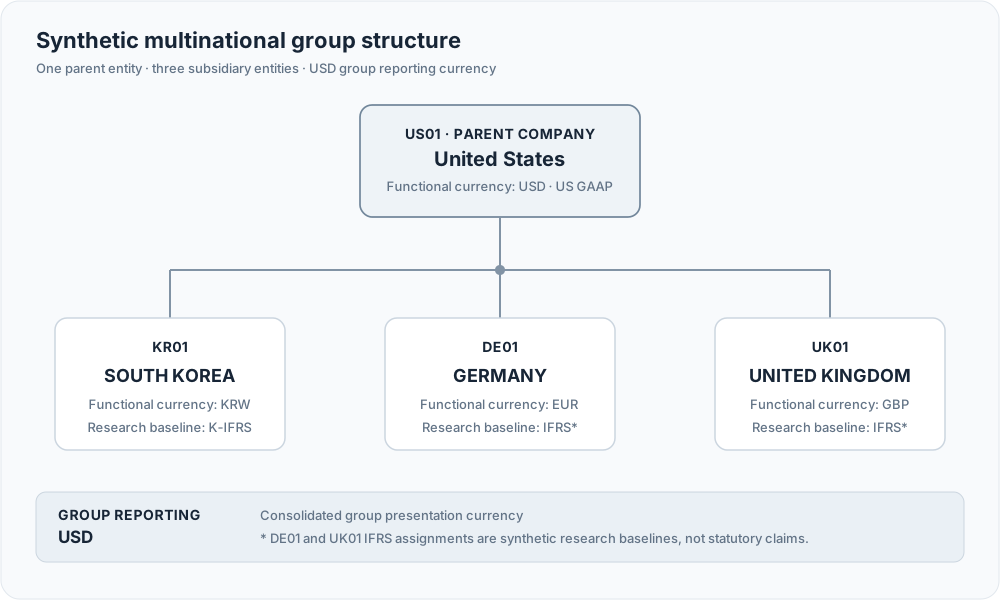
| Entity | Jurisdiction | Functional currency | Framework |
|---|---|---|---|
| US01 | United States | USD | US GAAP |
| KR01 | South Korea | KRW | K-IFRS |
| DE01 | Germany | EUR | IFRS |
| UK01 | United Kingdom | GBP | IFRS |
Group reporting currency: USD.
Multi-Currency Accounting
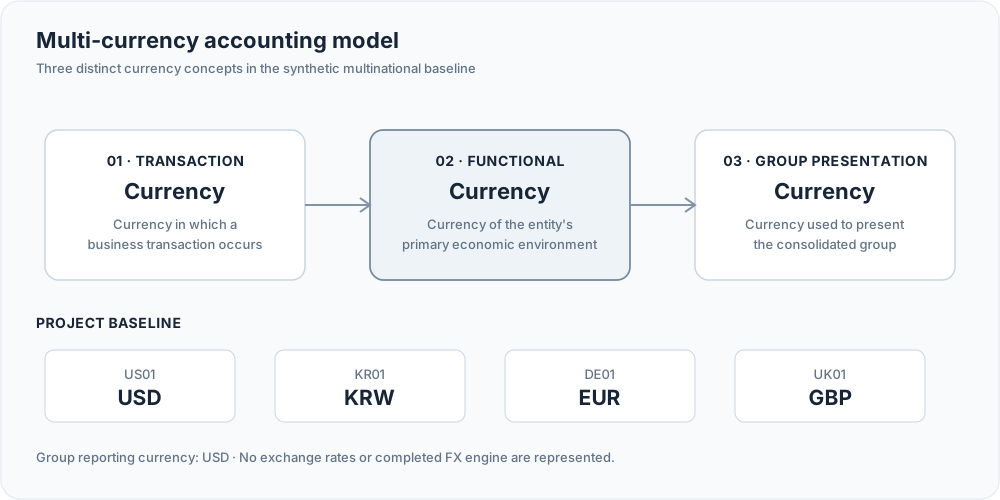
Transaction currency is the currency in which an underlying transaction is denominated. Functional currency is the currency of the primary economic environment of an entity. Group presentation currency is the currency used for the synthetic group view, which is USD.
The distinctions are essential because transaction evidence, entity measurement and group presentation address different accounting questions. Framework-specific exchange, translation and remeasurement policies therefore require explicit treatment. No exchange rates, conversion results or foreign-exchange engine are claimed as implemented.
General Ledger and Trial Balance
The demonstrated prototype currently covers event orchestration and draft-journal formation. General Ledger posting and Trial Balance generation remain planned and are not operational.
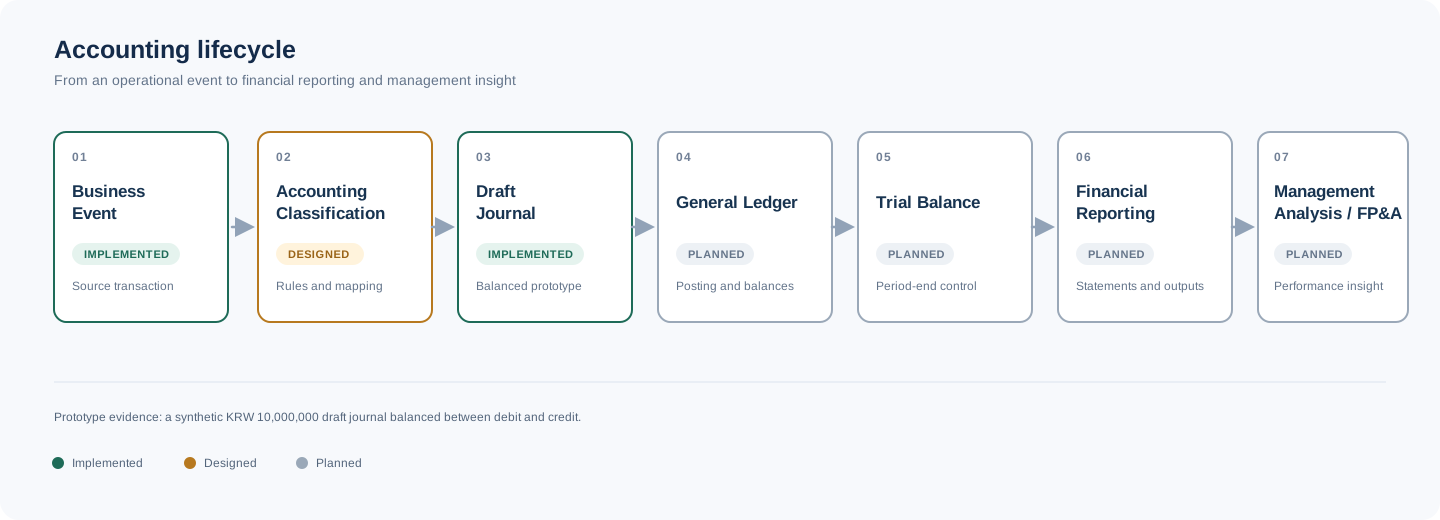
Future work will examine posting controls, period cut-off, debit and credit completeness, account balances and reconciliation between detailed ledger evidence and Trial Balance outputs.
Financial Reporting
Financial reporting research addresses the conceptual separation of journal evidence, ledger balances and externally oriented reports. The project will continue to evaluate framework presentation, entity reporting and consolidation considerations while preserving the distinction between draft, reconciled and final information.
Financial statement production is planned rather than implemented.
Manufacturing Accounting
Manufacturing accounting is a planned research direction focused on the evidence chain from purchasing and goods receipt through inventory, production, work in progress, finished goods and cost analysis.
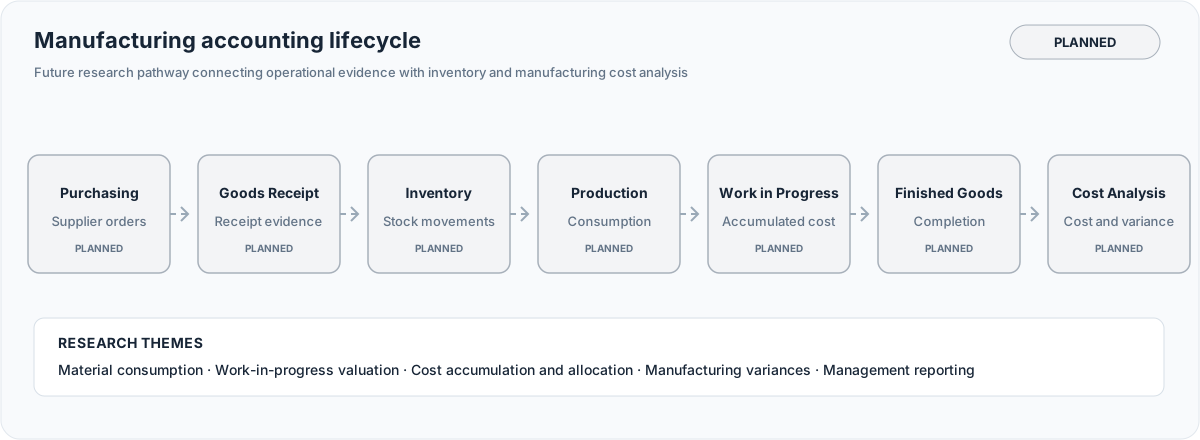
Further work will consider source evidence, valuation principles and the distinction between operational records and accounting representations. It is subject to later expansion and validation of the baseline accounting controls.
High-Level System Architecture
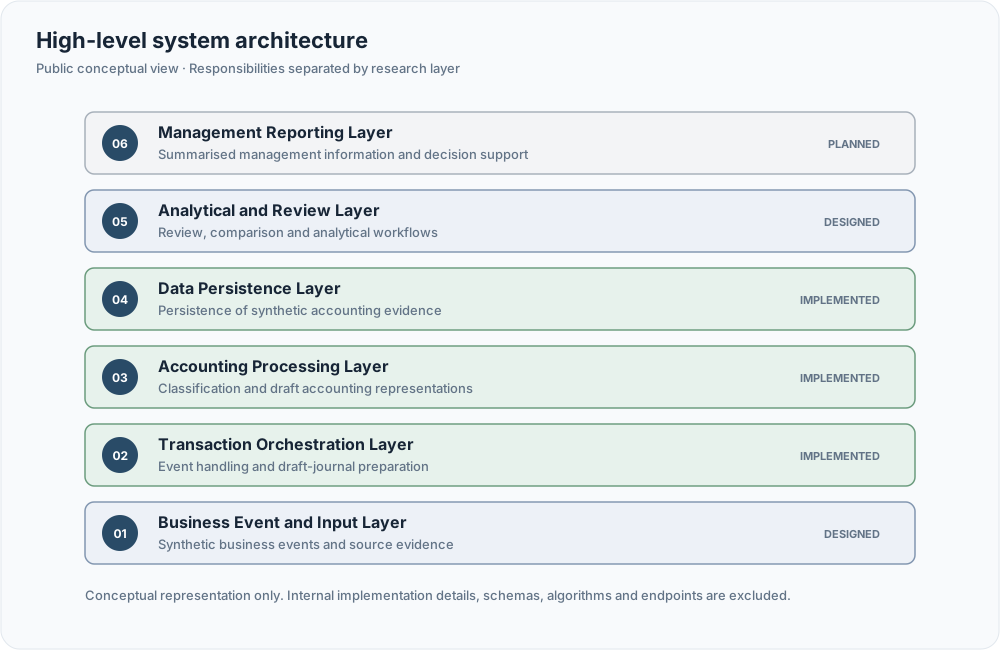
The public architecture separates the core responsibilities without exposing implementation detail:
Data persistence
A PostgreSQL persistence foundation records the research prototype's synthetic accounting evidence.
Accounting processing
Processing converts approved event patterns into classified, controlled accounting representations.
Transaction orchestration
Orchestration coordinates event handling and draft-journal preparation while supporting duplicate-event control.
Analytical workflows
Analytical and spreadsheet-based workflows support review, comparison and repeatable reporting preparation.
Management presentation
Management reporting presents summarized findings and is kept separate from financial statement production.
Development Progress
Evidence-based progress: 31.25%. This is calculated as 5 completed milestones divided by 16 identifiable approved milestones, multiplied by 100. The milestone register includes 5 Implemented, 3 Designed, 2 In Progress and 6 Planned items. Designed and in-progress items are not counted as completed; planned items do not contribute to the percentage.
Implemented Prototype evidence
- Accounting event-to-draft-journal orchestration.
- PostgreSQL persistence foundation.
- Synthetic Goods Receipt demonstration.
- Duplicate-event handling in the demonstrated workflow.
- Balanced synthetic draft journal with KRW 10,000,000 on each side.
Designed Research framework
- Chart of Accounts classification framework.
- Multinational entity structure and accounting-framework baseline.
- High-level separation of processing, persistence and reporting responsibilities.
In Progress Development
- Further development and integration of the accounting platform.
- Expansion and validation of accounting processes and controls.
Planned Future capability
- General Ledger posting.
- Trial Balance generation.
- Financial statement production.
- Broader multinational and multi-currency reporting.
- Manufacturing accounting workflows.
- Management reporting and FP&A capabilities.
Research Documentation
Public research documentation is intentionally limited to approved methodology, conceptual scope, synthetic examples and maturity status. It does not include source code, core accounting algorithms, internal SQL, schemas, credentials, internal endpoints or private datasets.
Internal research materials remain outside the public website and are not linked from this page.
Updates and Research Direction
Near-term research priorities are to strengthen accounting-process controls, document consistent event classifications and establish the evidence required for ledger and Trial Balance development. Public updates will be issued only when work has reached a reviewable and approved level of abstraction.
Status remains In Progress. No production readiness or commercial availability is claimed.